

Groceries, Farms & Food · Farms & Ranches
Behind the Oaks Farm
Our regenerative farm offers pasture-raised poultry and grass-fed and pasture-raised meat.
Schertz, TX
View ListingLocal Guides
Where to find real food from real farms around San Antonio — what to look for, what to ask, and the vendors worth building a week around.
The Crunch List Editorial Team · September 13, 2026 · 10 min read
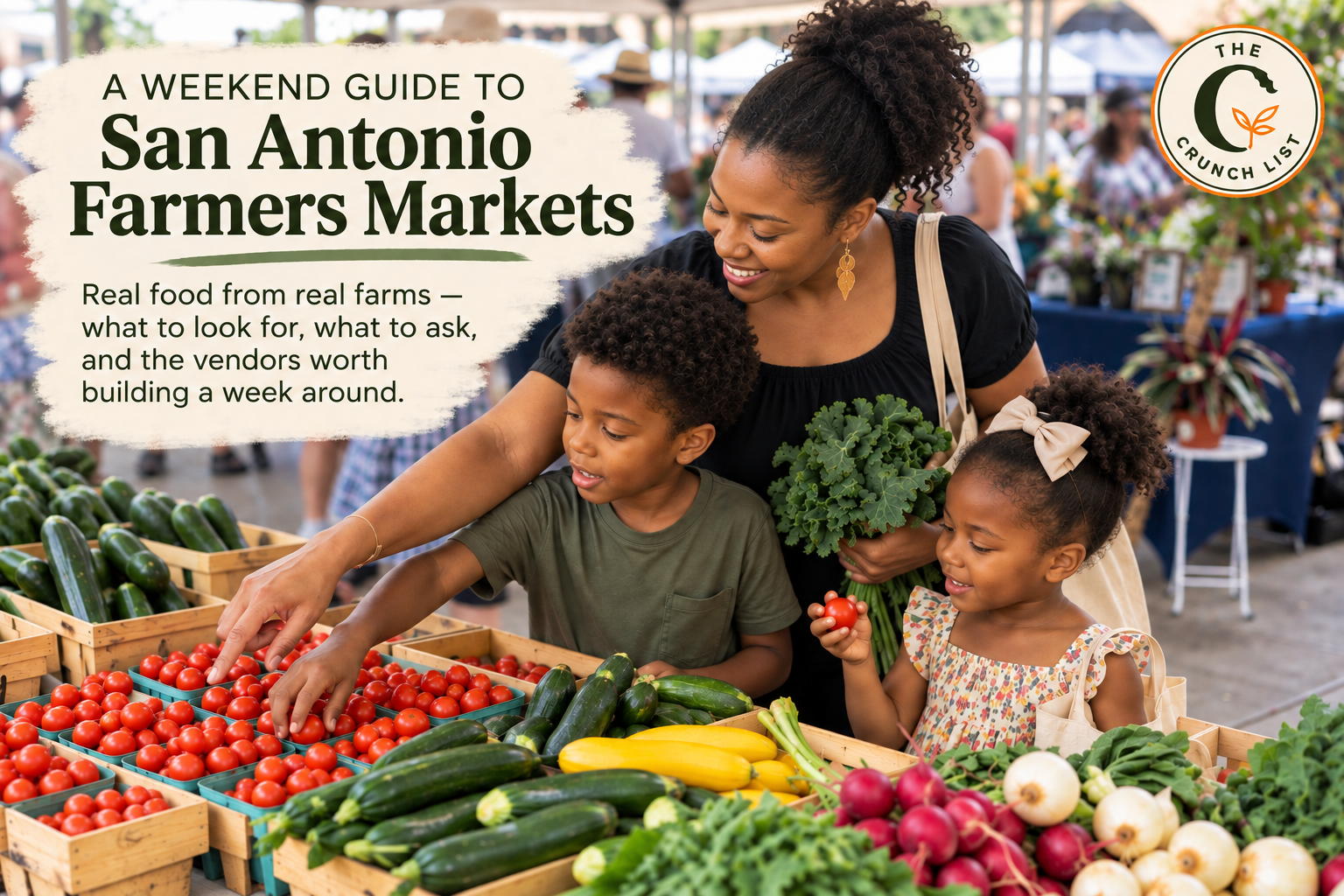
Where to find real food from real farms around San Antonio — what to look for, what to ask, and the vendors worth building a week around.
There is grocery shopping.
And then there is standing across a folding table from the person who actually grew your tomatoes, gathered your eggs or moved the chickens to fresh pasture that morning.
That is a completely different way to buy food.
One of the best parts about living in San Antonio is that you don't have to drive hours into the country to start building relationships with local farmers and ranchers. On any given weekend, farmers from across South Central Texas are setting up tables around the city with vegetables, eggs, meat, honey, bread, dairy and whatever happens to be growing well that season.
The harder part?
Figuring out which markets are actually worth visiting when your goal is local food — not just a fun Saturday morning with candles and handmade earrings.
Both have their place. But when you're trying to fill your refrigerator?
You want farmers.
So consider this your Crunch Guide to farmers market shopping around San Antonio: where to go, what to look for, what questions to ask and how to turn a Saturday morning outing into part of the way your family eats.
This is probably the most important thing to know before you go.
“Farmers market” can mean very different things depending on the market.
At some markets, the person standing behind the table must actually grow, raise or produce what they're selling. At others, the market may include resellers, artisans and businesses selling products made somewhere else.
Neither is inherently bad. But if your goal is to know where your food came from, look for terms like:
And when you're unsure?
Ask.
A good farmer generally doesn't mind telling you exactly where the food came from.
In fact, you may have trouble getting them to stop talking about it. 😆
Saturday | 9 a.m.–1 p.m. Pearl District, San Antonio
If you're new to buying local food in San Antonio, Pearl is probably the easiest place to start.
But here's something worth knowing: Saturday is the day you want.
Pearl's Saturday market is primarily a producers market. Farmers, ranchers and producers must be within 150 miles of San Antonio, and vendors are required to grow, produce, harvest or raise the products they're selling. Reselling isn't permitted.
That makes it considerably easier for shoppers who care about sourcing.
You'll find seasonal produce alongside eggs, meats, dairy, honey, bread and locally produced foods. Pearl's current vendor lineup includes farms and ranches such as 6G Heritage Farm, CKC Farm, Texas Dorper Lamb, Wild Acres Farm and Behind the Oaks Farm.
Crunch Guide tip: Go early.
Farmers aren't pulling unlimited tomatoes out of the back of the tent. Seasonal food can sell out, and early shoppers generally get the best selection.
And one more important distinction: Pearl's Sunday market is primarily its Makers Market, while Saturday is the market focused on farmers and ranchers.
So if you're coming for beef and eggs rather than pottery, make it a Saturday.
Saturday | Regularly 9 a.m.–1 p.m.; seasonal summer hours may differ Alamo Heights area
If Pearl is the big introduction to San Antonio's local food scene, Sunset Ridge is the market I would point someone toward when they say:
“No, really. I want to meet farmers.”
Sunset Ridge describes itself as San Antonio's regenerative farmers market, featuring local farmers and ranchers. Vendor attendance can change based on harvests and availability, which is exactly what you'd expect from a genuinely seasonal market.
It's smaller and less destination-y than Pearl — and that's part of the appeal.
You can slow down. Ask questions. Learn names.
And instead of thinking, “What cute thing should I buy today?” you can start thinking:
Who could become our egg farmer? Who could we buy beef from? Where could I get vegetables every week?
That's where farmers market shopping starts becoming something much more useful than a weekend activity.
A Vendor Worth Building Your Grocery Routine Around: Behind the Oaks Farm
One local farm particularly worth knowing is Behind the Oaks Farm, a regenerative farm in Schertz raising grass-fed beef along with pasture-raised poultry, pork, turkey and eggs.
They're currently at Pearl Farmers Market and Sunset Ridge Farmers Market on Saturdays, and they also operate an on-farm store in Schertz. Customers can even order ahead and pick up their order at the farmer’s market.
This is the kind of relationship that can completely change the usefulness of a farmers market.
Instead of wondering every Saturday what might be available, you can eventually get into a rhythm:
Order the meat.
Pick it up Saturday.
Grab eggs.
See what produce looks good.
Go home.
That's less “farmers market hobby” and more local food system.
And if you're curious about how your food is raised, Behind the Oaks also offers seasonal farm tours and private tours — which is about as close as you can get to knowing where dinner came from.
Mission Marquee Plaza Farmers & Artisans Market
First and third Saturdays | 9 a.m.–1 p.m. | March–November
For families on the South Side, Mission Marquee Plaza is another one to put on the calendar.
The City of San Antonio's Farmers & Artisans Market runs on select Saturdays and includes locally sourced food alongside local makers, community organizations and activities.
Because this one is not every Saturday, it's better treated as a check-the-calendar market than your automatic weekly grocery stop.
Sunday | Seasonal hours Alamo Quarry Market
Didn't make it out Saturday?
You're not doomed to a week of grocery-store tomatoes.
The Alamo Heights Farmers Market operates Sundays and, importantly, describes itself as a producers-only market with a no-resale policy.
That means the person selling the product should actually be connected to producing it — exactly the kind of transparency we're looking for.
Depending on the season, market hours change to accommodate Texas heat, so check before heading out. The market currently lists 10 a.m.–2 p.m. in cooler months and 9 a.m.–1 p.m. when temperatures climb.
If your goal is food rather than a huge market experience, this one deserves a spot in the rotation.
Sometimes the best farmers market isn't the one closest to your house.
If you don't mind making Saturday morning a little adventure, there are two excellent options just outside San Antonio.
Cibolo Farmers Market at Herff Farm
Saturday | 9 a.m.–1 p.m. Cibolo
This one may be the most charming option on the list.
The market takes place at historic Herff Farm in Boerne and brings together local growers and ranchers with produce, eggs, sustainably raised meats, preserves, baked goods and more.
The market's rules prohibit wholesale vendors and require agricultural produce to be grown in Texas.
And because you're actually shopping on a historic farm property — complete with gardens, trails and the Herff House — it can easily become a family Saturday morning rather than another errand.
Saturday | 9 a.m.–1 p.m. Downtown New Braunfels
If you're northeast of San Antonio, this may actually be more convenient than driving downtown.
The New Braunfels Farmers Market runs year-round on Saturdays and currently features more than 70 vendors, including farmers, ranchers and growers offering seasonal produce, eggs, pasture-raised meats, dairy, cheeses, breads, honey and other foods.
It's large enough that you could realistically make a substantial dent in your weekly grocery list while you're there.
This is where people sometimes get intimidated.
Don't.
You do not need to walk up to a farmer with a 37-point organic certification interrogation.
Start with normal questions.
For produce:
“Did you grow this?”
“Where is your farm?”
“What's especially good right now?”
“Do you spray anything on this crop?”
“What's coming into season next?”
Notice that I didn't say:
“Is this organic?”
That question can actually tell you less than you think.
Some very small farms use practices you may love but aren't certified organic. Others may use different methods depending on the crop.
Ask about practices, not just labels.
For eggs and poultry:
“How are your chickens raised?”
“Are they able to get outside?”
“Are they moved onto fresh pasture?”
“What do you feed them?”
For beef:
“Is the beef grass-fed?”
“Is it grass-finished or grain-finished?”
“Are the cattle raised on your farm?”
For pork:
“Are the pigs pasture-raised?”
“What are they fed?”
“Are they raised here locally?”
You don't have to ask every question every week.
You're building a relationship.
Once you find farmers whose practices align with what matters to your family, shopping gets much simpler.
This one is surprisingly slippery.
Something being sold at a local market does not necessarily mean every ingredient was grown five miles down the road.
A loaf of sourdough can be made locally while using wheat grown elsewhere.
A jar of salsa can be made in San Antonio from ingredients sourced from multiple places.
A rancher can be local while using a processor in another Texas town.
That doesn't automatically make any of those things bad.
The goal isn't to achieve some imaginary 100% locally sourced purity badge.
The goal is transparency.
Know what you're buying.
Decide what matters to you.
Spend accordingly.
Very crunchy. Very reasonable. 😆
One of the biggest mindset shifts when you start buying from actual farms is realizing that nature has absolutely no interest in your meal plan.
You may want strawberries.
The farm may have squash.
Lots and lots of squash.
Local eating means allowing what's growing to influence what you're cooking rather than expecting every fruit and vegetable to be available 365 days a year.
That is also part of what makes farmers markets fun.
Tomato season actually feels exciting when tomatoes haven't been pretending to be in season since January.
Peaches become an event.
The first cooler-weather greens feel like a change of season.
Food starts having a calendar again.
Here's the part I wish more farmers market guides talked about.
You don't need to buy everything locally.
You don't need to abandon H-E-B.
You don't need to spend Saturday visiting four farms while wearing linen overalls.
Start with three things.
Maybe:
Meat + eggs + one seasonal vegetable.
Find a rancher you trust for meat.
Find someone for eggs.
Then walk the produce booths and buy whatever looks good.
Next month, maybe you find your honey person.
Then your sourdough person.
Then someone texts you that their chickens are laying like crazy and suddenly you're buying four dozen eggs in a church parking lot.
This is how it happens. 😂
Little by little, anonymous grocery-store purchases begin turning into relationships with actual people.
If you're completely new, here's where I'd start.
Saturday morning: Visit Pearl Farmers Market if you want the widest introduction to local producers, or Sunset Ridge if your priority is talking directly with regenerative farmers and ranchers.
Buy your week's meat and eggs first.
Then shop seasonal produce.
Grab bread, honey or something fun if you have room in the budget.
Sunday: If you missed Saturday — or forgot something — head to Alamo Heights Farmers Market.
And once you get comfortable?
Take a Saturday trip to Herff Farm or New Braunfels and explore a little farther from home.
Eventually, the goal isn't to visit every farmers market in San Antonio.
It's almost the opposite.
Find your people.
Find the farmer whose eggs you buy every week.
The rancher you trust with your family's meat.
The grower who tells you, “Don't buy the tomatoes this week. Wait until next Saturday.”
That's when shopping local stops being a trend and starts becoming part of your family's rhythm.
And that's exactly what The Crunch List is here to make easier.
Farmers markets are wonderfully seasonal — which also means vendors, produce and even operating hours can change.
Check the market's current schedule before making a special trip, especially around holidays, severe weather and seasonal hour changes.
And bring a cooler.
Future-you will be very grateful when you decide to buy six pounds of pasture-raised ground beef at 9:14 in the morning.
Groceries, Farms & Food · Farms & Ranches
Our regenerative farm offers pasture-raised poultry and grass-fed and pasture-raised meat.
Schertz, TX
View ListingMentions are editorial. They are not paid placement.
Food & Sourcing
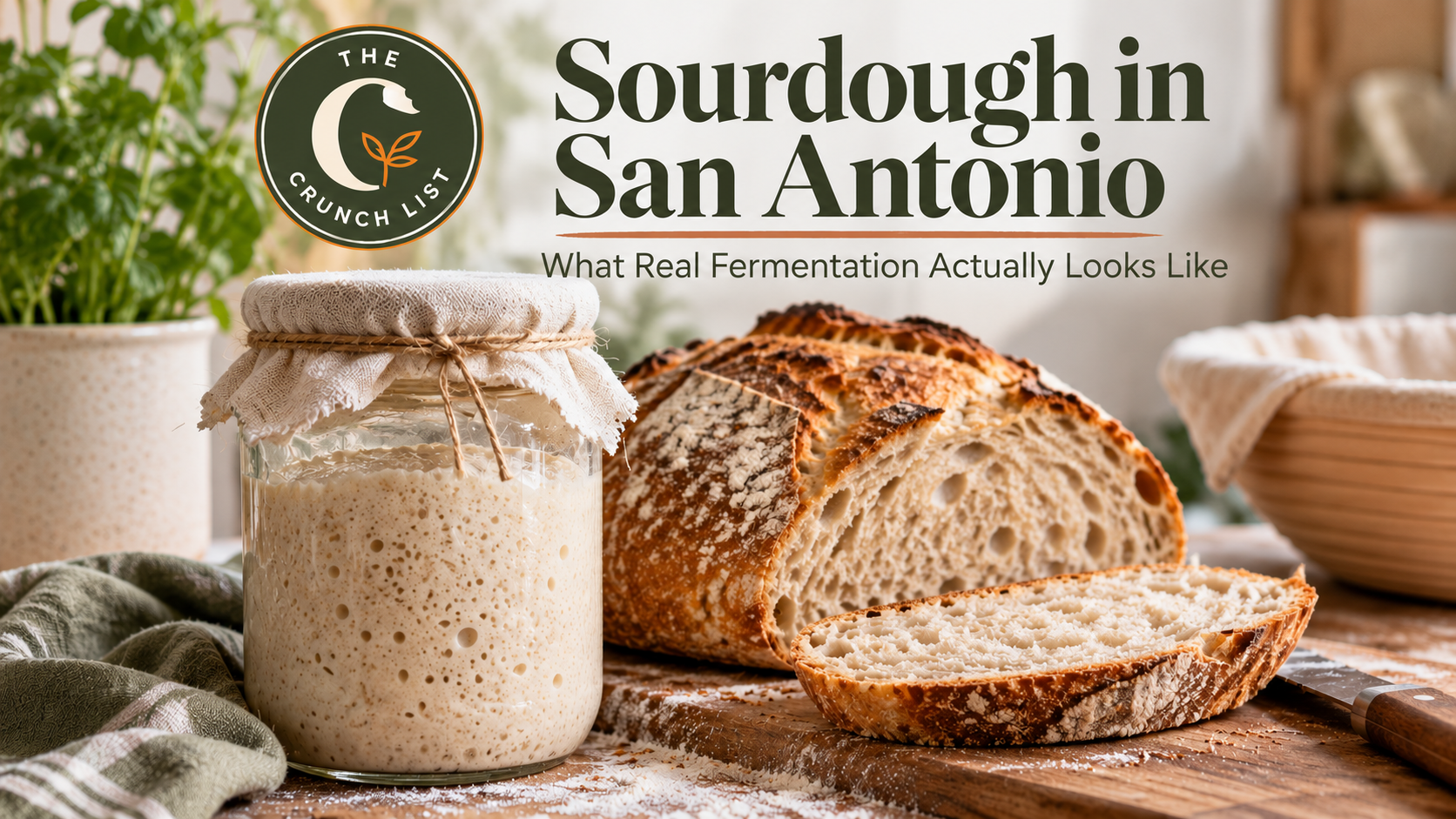
Not every loaf labeled sourdough is fermented the traditional way. Here is how to tell the difference — and where to find the real thing in San Antonio.
Getting Started
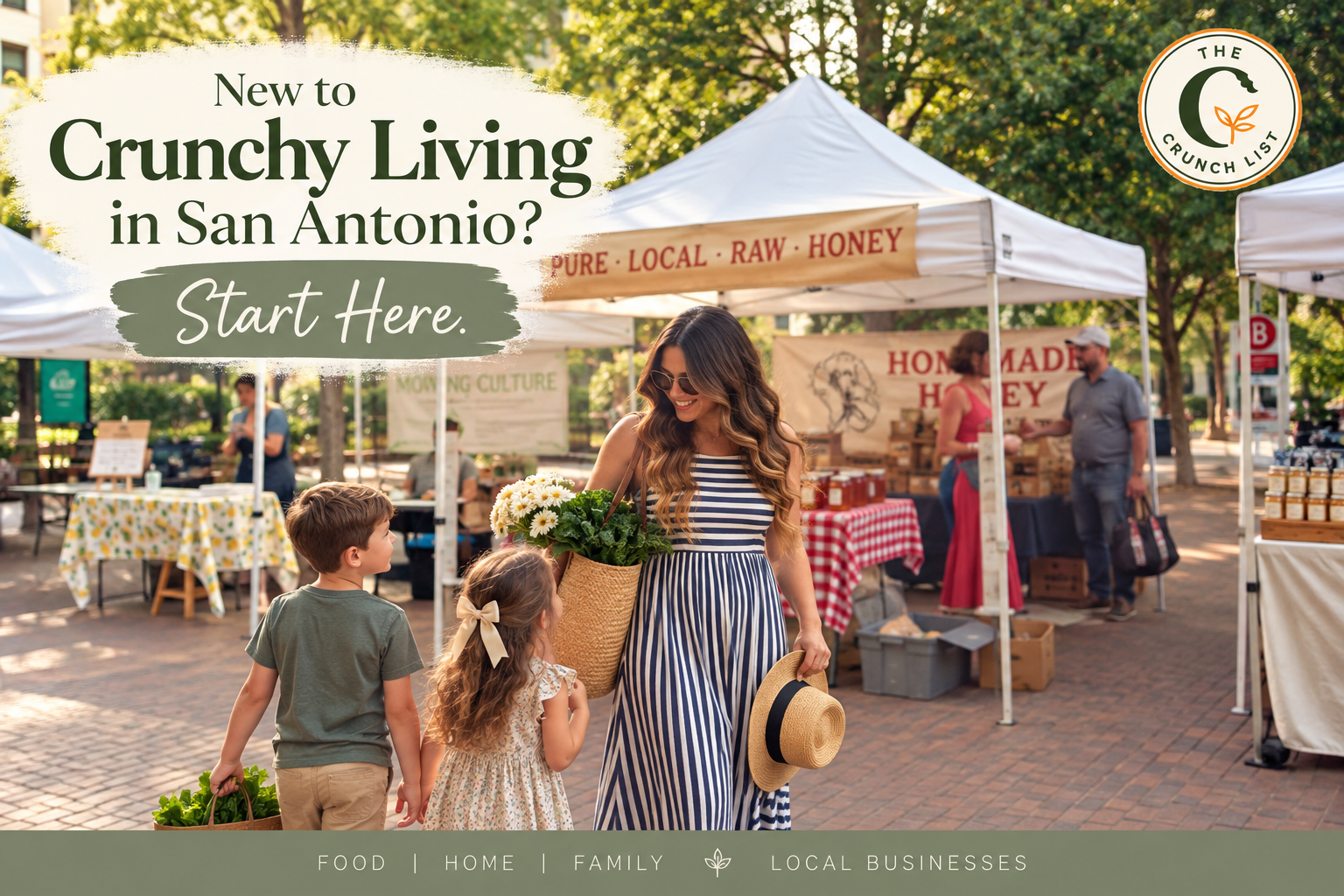
No purges, no perfectionism. A sane on-ramp to eating better, cleaning safer, and raising kids a little crunchier in San Antonio.

Food & Sourcing
How herd shares work, what the law says, and where to start locally.