

Eat & Drink · Bakeries
Loaf Sourdough Panaderia
Loaf Sourdough Panaderia everything we serve is sourdough, made with only organic ingredients, and dairy free!
San Antonio, TX
View ListingFood & Sourcing
Not every loaf labeled sourdough is fermented the traditional way. Here is how to tell the difference — and where to find the real thing in San Antonio.
The Crunch List Editorial Team · August 12, 2026 · 9 min read
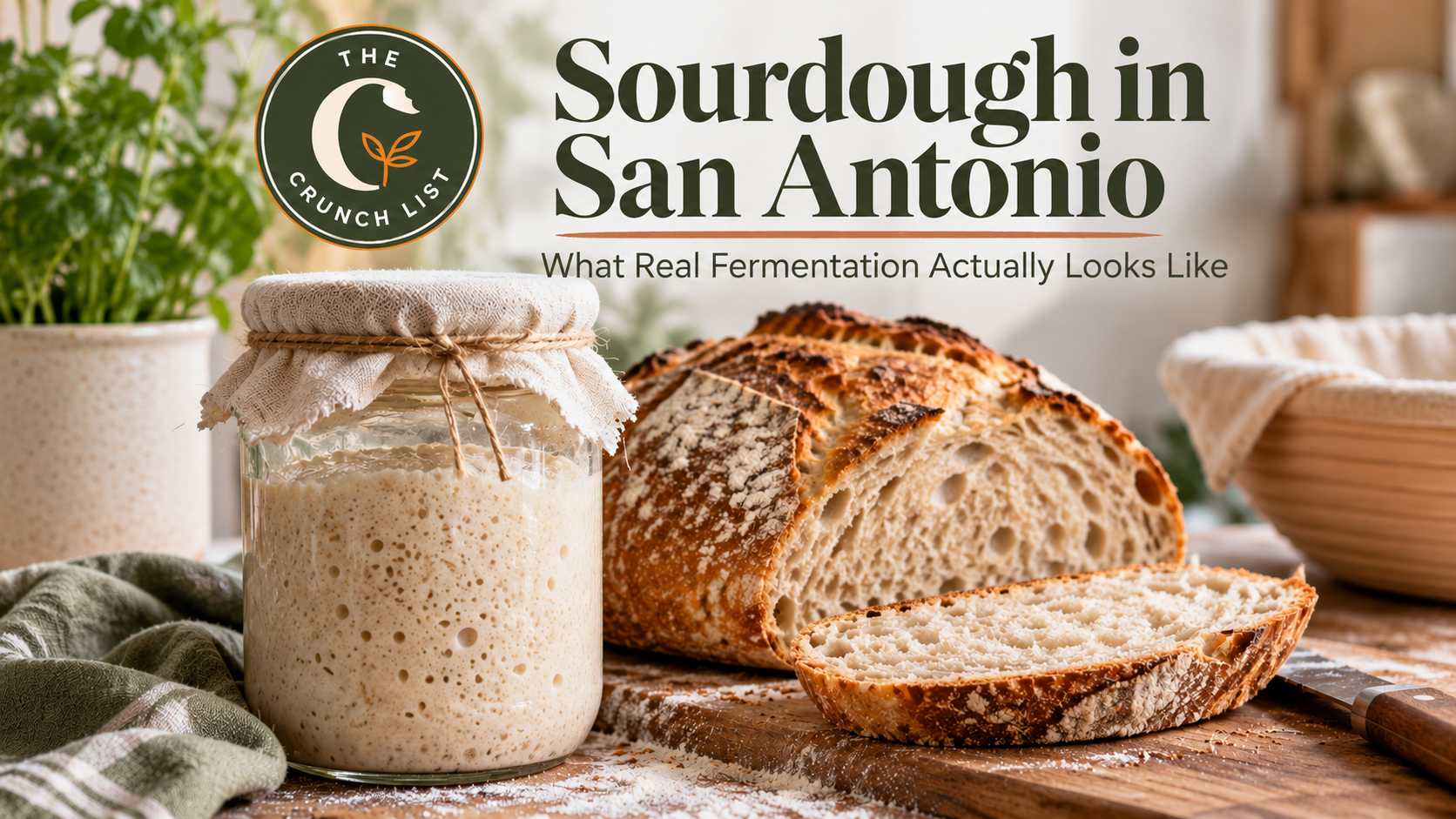
There is something about sourdough that makes it feel like the unofficial bread of crunchy living.
Maybe it is the flour-dusted boule sitting on the counter. Maybe it is the glass jar of starter bubbling next to the sink. Or maybe it is the fact that making a loaf traditionally requires something we have mostly engineered out of modern food production:
Time.
But walk through the bread aisle today and you will see “sourdough” everywhere.
Sourdough sandwich bread. Sourdough English muffins. Sourdough crackers. Sourdough pizza crust.
Which raises a pretty reasonable question:
Is all of it actually sourdough?
Not necessarily.
Traditional sourdough is less about whether a loaf tastes slightly tangy and more about how the dough was fermented and leavened.
Here is what that actually means — and how to find traditionally fermented sourdough around San Antonio.
Traditional sourdough begins with something wonderfully unimpressive:
Flour + water.
Given enough time, naturally occurring yeasts and bacteria establish themselves in that mixture and create what bakers call a starter.
That starter becomes the leavening culture used to make the bread rise.
Unlike conventional bread, which can rely on packaged commercial yeast to rise quickly, naturally leavened sourdough gets its lift from the microorganisms living in the starter. Those microorganisms also produce the organic acids responsible for sourdough's characteristic flavor. (Source: King Arthur Baking)
And this is where the biggest difference comes in:
A conventional loaf can move through production relatively quickly.
Traditional sourdough fermentation may continue for many hours — sometimes overnight or for multiple days depending on the baker's process.
During that time, yeast and lactic acid bacteria are actively fermenting the dough.
That slow process develops the flavor, texture and character people associate with artisan sourdough.
Real sourdough isn't just a flavor. It is a fermentation process.
Because there isn't one universal sourdough recipe.
A crusty artisan boule with four ingredients can be sourdough.
A soft sandwich loaf containing butter or honey can also incorporate a sourdough culture.
Some bakers also use a sourdough starter plus a small amount of commercial yeast to make fermentation more predictable. King Arthur Baking, for example, distinguishes its fully naturally leavened loaf from another sourdough recipe that includes packaged yeast as backup. (Source: King Arthur Baking)
So seeing “yeast” on an ingredient list doesn't automatically tell you everything about how a bread was made.
What matters more is understanding the process.
If you're specifically looking for traditional, naturally leavened sourdough, you want to know:
Was a live sourdough starter used to leaven the bread, and was the dough given time to ferment?
That question will tell you far more than the word sourdough printed across the bag.
How to Tell If You're Buying Traditionally Fermented Sourdough
You don't need to interrogate your neighborhood baker like you're conducting a bread investigation.
A few clues can tell you quite a bit.
Traditional sourdough depends on an active culture of wild yeast and bacteria.
A bakery might call it:
Some bakeries even name theirs.
And yes, sourdough people absolutely get attached to jars of flour and water.
We don't make the rules.
This may be the most useful question of all.
“How long do you ferment your sourdough?”
You are generally looking for an answer measured in many hours rather than “we mix it in the morning and have bread an hour later.”
There isn't one magic number that separates “real” from “fake” sourdough. Fermentation time depends on starter strength, temperature, flour, hydration and the bread being made.
But extended fermentation is a hallmark of traditional sourdough baking.
Monash University's researchers describe traditional sourdough as involving a prolonged proof — commonly more than 12 hours — during which the sourdough microorganisms ferment carbohydrates in the dough. (Source: Monash FODMAP)
Some local San Antonio-area bakers go considerably longer than that.
We'll get to them below.
Plot twist:
Good sourdough doesn't have to taste extremely sour.
The flavor can range from mild and almost creamy to noticeably tangy depending on fermentation temperature, starter maintenance and how acids develop in the dough.
Wild yeast and bacteria produce both lactic and acetic acids, and bakers can manipulate fermentation conditions to change that balance. (Source: King Arthur Baking)
So a bread being aggressively sour isn't proof that it underwent some exceptionally traditional fermentation process.
And a mild loaf isn't automatically fake.
A basic artisan sourdough may contain only:
flour + water + salt + starter
And technically, the starter itself is simply flour and water populated with yeast and bacteria.
But inclusions aren't automatically a red flag.
Jalapeño cheddar sourdough is still sourdough.
Rosemary garlic sourdough is still sourdough.
Olive sourdough?
We support her too.
The ingredient list tells you what's in the loaf.
The baker's process tells you how it became sourdough.
This is the part where sourdough gets genuinely fascinating.
Once starter is mixed with flour and water, the yeast and bacteria begin consuming carbohydrates in the dough.
Yeasts generate carbon dioxide, helping the bread rise.
Lactic acid bacteria and yeast also create organic acids and flavor compounds that give fermented bread its complexity. (Source: King Arthur Baking)
Longer traditional fermentation can also change some of the carbohydrates present in bread.
For example, research summarized by Monash University shows that sourdough microorganisms can reduce some fructans, a type of FODMAP found in wheat, during prolonged fermentation. That is one reason certain traditionally fermented sourdough breads may be tolerated differently by some people with IBS. (Source: Monash FODMAP)
But there is an important distinction here.
Wheat sourdough still contains gluten and is not appropriate for someone with celiac disease simply because it has been fermented longer. Monash specifically cautions against confusing lower-FODMAP sourdough with gluten-free bread. (Source: Monash FODMAP)
So rather than treating sourdough as some magical bread that everyone can suddenly digest, think of fermentation as a traditional process that changes the dough.
Individual tolerance still varies.
Now for the part we really care about.
San Antonio has a growing little ecosystem of bakers taking the slow route.
These businesses specifically describe their breads as naturally fermented, naturally leavened or made with wild yeast rather than simply putting “sourdough” on the menu.
4.9 stars Bakery
If a bakery putting Sourdough directly in its name doesn't give away the specialty, the bread case probably will.
This San Antonio panadería focuses on long-fermented, naturally leavened sourdough breads and sourdough-based baked goods.
It is an especially interesting stop if you like the overlap between traditional fermentation and a panadería-inspired bakery rather than strictly European-style artisan bread.
1031 Patricia Drive #104, San Antonio
4.6 stars Bakery
Something Sourdough Co. is unusually transparent about its process, which makes it exactly the kind of bakery we like to find for a guide like this.
The bakery says its sourdough is naturally fermented with wild yeast, contains no commercial yeast or artificial additives, and receives a 36+ hour fermentation/cold proof. It also uses organic grains along with ingredients such as local honey, grass-fed dairy and pasture-raised eggs in various baked goods. (Source: Something Sourdough Co)
They make far more than boules, too — think sourdough cinnamon rolls, cookies, scones and other fermented baked goods.
3030 Thousand Oaks Drive #105, San Antonio
4.9 stars Bakery
A little farther northwest in Old Town Helotes, Spread the Loaves may be one of the clearest examples of the slow-bread philosophy.
Their loaves are naturally leavened with an in-house starter affectionately named Kuchi Kopi and receive a two- to three-day ferment. (Source: Spread The Loaves)
The bakery regularly offers classic and flavored sourdough loaves along with sourdough focaccia, bagels, baguettes and rotating specials. (Source: Spread The Loaves)
This is very much a “go early or preorder” kind of place; the bakery itself recommends arriving earlier in the day for the widest selection.
14743 Old Bandera Road, Helotes
4.6 stars Bakery
One of San Antonio's longtime bread institutions, Broadway Daily Bread has been baking locally since the 1990s and mills some of its whole-grain flour in-house.
Its Wednesday bread lineup includes what the bakery describes specifically as a “Natural Traditional Sourdough,” along with rosemary-olive sourdough and an Italian-style Pugliese sourdough. (Source: Broadway Daily Bread)
This one is worth remembering because sourdough isn't available every day — check the current bread schedule before making the trip.
5001 Broadway, San Antonio 5011 De Zavala Road, San Antonio
San Antonio's farmers markets are also full of cottage bakers and microbakeries, and some truly fantastic loaves never make it into a storefront.
If you see a beautiful boule at a market and want to know how it was made, don't worry about memorizing an ingredient science textbook.
Just ask:
Do you use sourdough starter as your leavening? How long does your dough ferment? Do you add commercial yeast?
A baker who is spending 24, 36 or 48 hours babysitting dough will usually be very happy to tell you about it.
Fair warning:
You may accidentally receive the entire biography of their starter.
We consider this a feature, not a bug.
Here is where we resist turning this into another internet food purity contest.
You don't need to throw away the loaf sitting on your counter because its ingredient list doesn't pass somebody's TikTok test.
Sometimes you need sandwich bread.
Sometimes the kids are hungry.
Sometimes the grocery store is where you're shopping.
And sometimes a commercial loaf is simply what fits your budget and your week.
The goal isn't perfection.
It is knowing what you're buying.
If you specifically want the long-fermented bread that people are referring to when they talk about traditional sourdough, look beyond the marketing on the front of the package.
Read the ingredients.
Ask about the starter.
Ask about fermentation time.
And when you can, buy a loaf from the local baker who spent two days making it.
That feels pretty crunchy to us.
Traditional sourdough is beautifully simple:
Flour. Water. Salt. Microorganisms. Time.
It doesn't require a pristine farmhouse kitchen, a 200-year-old starter brought over from Europe or a linen apron dusted dramatically with flour.
But it does require fermentation.
And in a food system built around making everything faster, there is something refreshingly old-fashioned about a loaf that simply can't be rushed.
Fortunately, you don't have to bake one yourself to experience it.
There are San Antonio bakers keeping starters alive, fermenting dough overnight — sometimes for several days — and quietly making really good bread right here in our community.
And that is exactly the kind of thing The Crunch List exists to help you find.
Look for:
Remember:
Commercial yeast doesn't automatically mean a bread has no sourdough fermentation at all, and “sourdough” doesn't automatically mean a loaf was naturally leavened for 24 hours.
Process matters more than the buzzword.
Eat & Drink · Bakeries
Loaf Sourdough Panaderia everything we serve is sourdough, made with only organic ingredients, and dairy free!
San Antonio, TX
View ListingEat & Drink · Bakeries
NO seed oils, corn syrup, hydrogenated oils or trans-fat. only real ingredients.
San Antonio, TX
View ListingEat & Drink · Bakeries
A tiny, bread-focused bakery in Helotes, TX, specializing in sourdough-leavened breads.
Helotes, TX
View ListingEat & Drink · Bakeries
Broadway Daily Bread® is home to some of the finest baked goods in San Antonio since 1994.
San Antonio, TX
View ListingMentions are editorial. They are not paid placement.
