

Local Guides
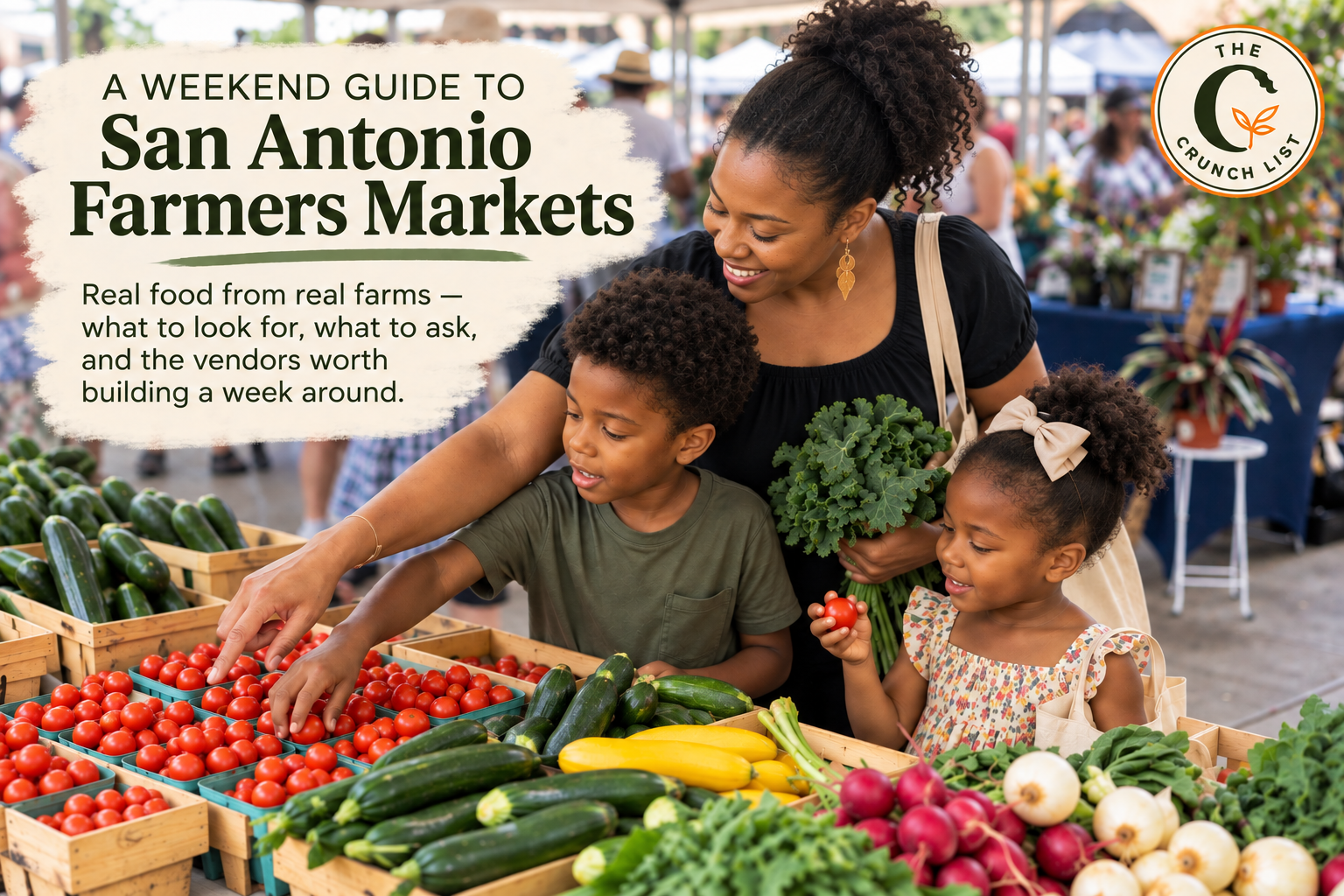
A Weekend Guide to San Antonio Farmers Markets
Where to find real food from real farms around San Antonio — what to look for, what to ask, and the vendors worth building a week around.
The Crunch List · Sep 13, 2026
Getting Started
No purges, no perfectionism. A sane on-ramp to eating better, cleaning safer, and raising kids a little crunchier in San Antonio.
The Crunch List Editorial Team · August 18, 2026 · 11 min read
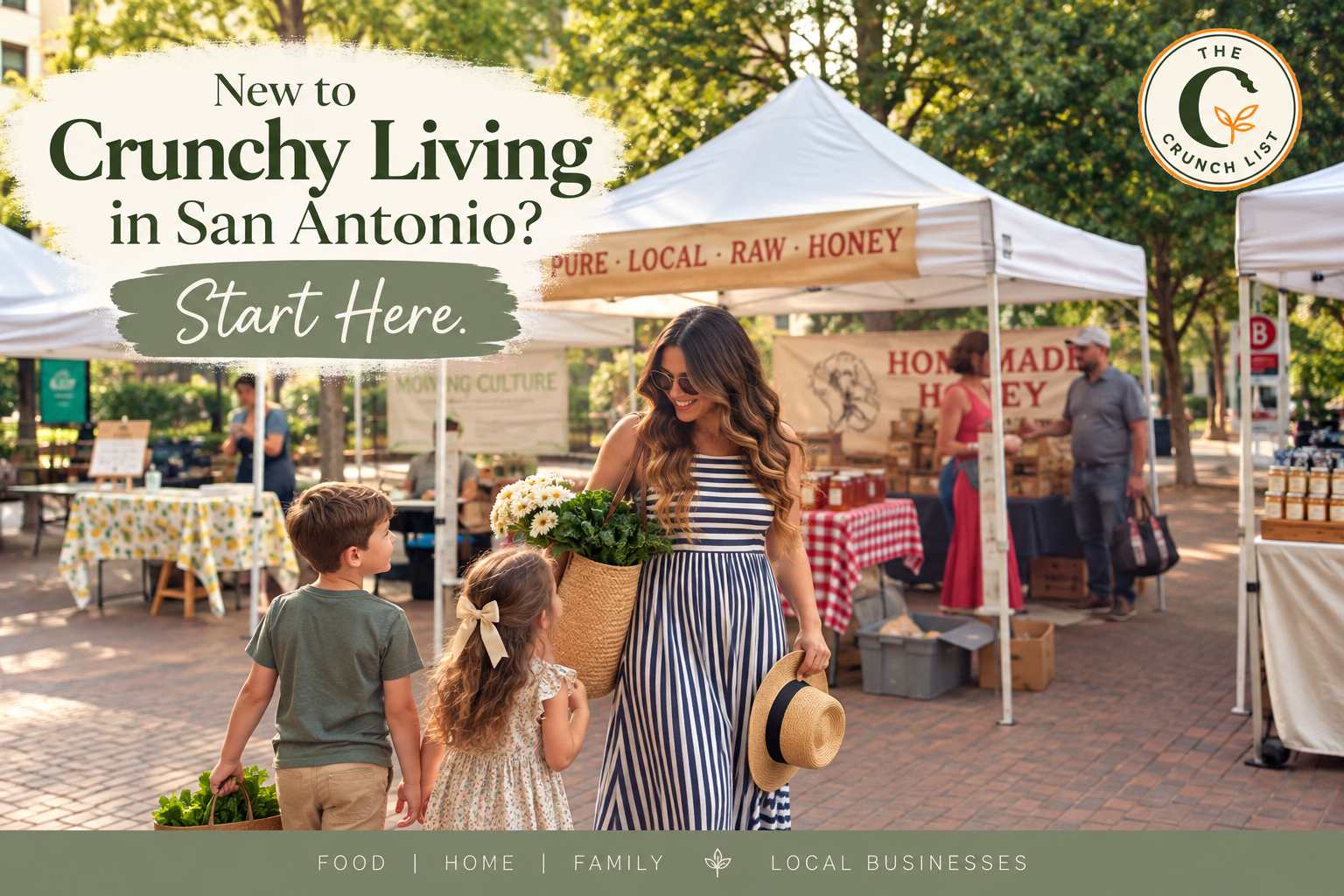
No purges, no perfectionism. A sane on-ramp to eating better, cleaning safer, and raising kids a little crunchier in San Antonio.
Maybe you bought your first loaf of sourdough and suddenly your algorithm decided you should be milling your own wheat, making tallow lotion, fermenting vegetables, raising backyard chickens, replacing every cleaning product in your house, and driving 45 minutes to pick up raw milk from a farm.
Welcome. 😆
If you’re new to crunchy living, it can get overwhelming very quickly.
One minute you’re wondering whether there’s a better cereal for your kids, and the next you’re standing in your kitchen staring suspiciously at everything you’ve ever purchased.
But here’s the good news:
You do not have to overhaul your entire life to live a little crunchier.
You don’t have to throw everything away. You don’t have to make everything from scratch. You definitely don’t have to spend your entire paycheck at a specialty grocery store.
Crunchy living can simply mean becoming a little more intentional about the food you eat, the products you bring into your home, the businesses you support, and the choices you make for your family.
And if you live in San Antonio, you have more options than you might realize.
Consider this your beginner-friendly guide to crunchy living in San Antonio—with absolutely no perfection required.
There isn’t one official definition.
Some people hear “crunchy” and immediately picture backyard chickens, cloth diapers, homemade sourdough, and a cabinet full of herbs.
And sure. That can be crunchy.
But crunchy living exists on a very large spectrum.
For one family, it might mean buying grass-fed beef directly from a local farmer.
For another, it’s switching to fragrance-free laundry detergent.
Someone else might grow vegetables, use low-tox cleaning products, choose a holistic healthcare provider, avoid artificial food dyes, or look for restaurants that cook with ingredients they feel good about feeding their children.
You can care about organic food and still eat Whataburger sometimes.
You can use cast iron and still own a microwave.
You can make homemade bone broth and also have frozen chicken nuggets in your freezer.
There are no Crunchy Police.
The goal isn’t perfection.
The goal is simply to make better choices where they make sense for your family.
One of the biggest mistakes people make when they become interested in non-toxic or natural living is thinking they need to immediately replace everything they own.
Please don’t.
Your bank account does not need that kind of trauma.
Instead, try this:
When something runs out, replace it with a better option.
Finish the dish soap you already bought.
When it’s empty, look for one with ingredients you prefer.
Use the laundry detergent you currently have.
When you need another bottle, consider trying a fragrance-free or lower-tox alternative.
Your plastic food storage containers do not need to dramatically disappear from your kitchen tonight. As they wear out, you might slowly replace them with glass.
This approach is much more affordable, much less wasteful, and much more sustainable long-term.
Crunchy living becomes part of your normal life instead of becoming a giant project you abandon three weeks later.
Food is often the gateway into crunchy living.
And unfortunately, it’s also where people can become overwhelmed fastest.
Organic.
Grass-fed.
Grass-finished.
Pasture-raised.
Regenerative.
Non-GMO.
Seed-oil-free.
Raw.
Local.
Suddenly grocery shopping requires a vocabulary test.
You do not need to tackle all of it at once.
Start with one or two changes that matter most to you.
Try buying a few foods directly from local farms
One of the wonderful things about living in the San Antonio area is that we have access to farms and ranches throughout South Central Texas.
Depending on the farm, you may be able to purchase things like:
Buying directly from farmers also gives you something a grocery-store label often can't: the opportunity to ask questions.
How are the animals raised?
What do they eat?
Are pesticides used?
Are antibiotics routinely used?
How is the milk handled?
You don’t have to memorize every certification when you can actually talk to the person producing your food.
That connection between families and local producers is one of the things we hope to make much easier through The Crunch List.
Upgrade the foods your family eats most
You also don't need an entirely organic grocery cart.
Look at what your family eats constantly.
If your kids eat eggs every morning, maybe eggs are where you choose to spend a little more.
If your family goes through gallons of milk, perhaps researching your milk options feels worthwhile.
If strawberries disappear within 24 hours of entering your house, you might decide to prioritize those.
Make the biggest improvements where they’ll actually have the biggest impact in your home.
Once you start paying attention to ingredients, grocery shopping can become mildly alarming.
But you also don't need to stand in H-E-B reading 47 shampoo bottles while your children slowly dismantle the aisle.
Start with awareness.
Turn the package around.
Look at the ingredient list.
Compare two products.
Ask yourself:
Which one is simpler?
Over time, you'll start recognizing ingredients you personally prefer to limit or avoid.
And remember: “natural” on the front of a package does not automatically tell you much about what's inside it.
The front of the package is marketing.
The back is where the interesting stuff lives.
You don't need fourteen different cleaners.
In fact, getting crunchier can sometimes mean buying less, not more.
As products run out, consider replacing them with simpler alternatives.
Depending on what you're cleaning, that might include things like:
And before anyone comes for us: vinegar does not need to be sprayed on every surface known to mankind.
Crunchy does not mean abandoning common sense.
The goal is simply to reduce unnecessary exposures where you reasonably can while still having a house that is actually clean.
If you want one very simple place to begin with lower-tox living, start noticing how many fragranced products are in your home.
Laundry detergent.
Fabric softener.
Dryer sheets.
Candles.
Plug-ins.
Room sprays.
Hand soap.
Dish soap.
Shampoo.
Body wash.
Cleaning sprays.
Trash bags.
Sometimes even toilet paper.
You don't necessarily have to eliminate fragrance completely, but becoming aware of how many scented products you use can help you decide which ones actually matter to you.
A fragrance-free laundry detergent, for example, may be one of the easiest swaps a family can make.
Small changes count.
Crunchy living doesn't stop at the grocery store.
The materials and products we use inside our homes matter too.
Painting a room?
You can ask about low- or zero-VOC paint options and talk with your painter about ventilation and healthier indoor painting practices. The EPA specifically provides guidance around reducing indoor exposure while painting. citeturn117319search2
Here in the San Antonio area, Dye Renovations can accommodate homeowners who request environmentally friendly and zero-VOC paint options.
That means you don't necessarily have to choose between wanting your house updated and wanting to be thoughtful about the products being used inside it.
The same principle applies to flooring, furniture, mattresses, pest control, landscaping, remodeling, and dozens of other household decisions.
You don't have to renovate your entire house into an organic hemp compound.
Just ask better questions when it's time to make a purchase anyway.
Your crunchy journey can continue right out the back door.
San Antonio's climate makes water-conscious and environmentally thoughtful lawn care especially relevant.
The City of San Antonio encourages residents to consider environmentally safer lawn products, organic fertilizers and pest-control methods, proper use of lawn chemicals, composting or reusing grass clippings, and keeping yard waste out of storm drains. citeturn117319search0
Native and drought-tolerant landscaping can also help reduce water demand and support local ecosystems.
That doesn't mean you need to rip out your lawn tomorrow.
It might simply mean:
Choosing native plants when you add landscaping.
Being more intentional about fertilizer and weed treatments.
Composting yard waste.
Watering more thoughtfully.
Or working with a lawn-care company that understands eco-conscious practices.
Redeemed Lawn Care serves the San Antonio area and incorporates environmentally friendly and eco-conscious approaches into its work.
Finding local businesses willing to work with your family's priorities can make crunchy living considerably easier.
Parenting is probably where crunchy living becomes the most emotionally loaded.
We all want to make good choices for our kids.
But trying to protect children from every questionable ingredient, chemical, plastic toy, artificial dye, screen, processed food, and birthday cupcake is a very efficient way to make yourself crazy.
Choose your priorities.
Maybe you cook most meals at home but don't worry about what Grandma feeds them.
Maybe you avoid food dyes at home but your child still gets cake at birthday parties.
Maybe you choose wooden toys sometimes and absolutely still own LEGOs.
Maybe your kids drink raw milk at home and eat Chick-fil-A with their friends.
The goal is not to create children who panic when somebody hands them a Goldfish cracker.
It's to build a home where healthier choices are normal.
Crunchy living should support your family.
It shouldn't become another source of anxiety.
One of the best ways to start living a little crunchier—especially if you have children—is to actually meet the people producing your food.
Visit a farm.
Talk to the farmer.
Let your kids see chickens scratching in the grass and cattle grazing in a pasture. Ask how the animals are raised, what they're fed, how the land is managed, and why the farmer chooses to do things the way they do.
There is something incredibly grounding about reconnecting food with the people, animals, and land that produced it.
And you can do exactly that right here in the San Antonio area.
Visit a Local Regenerative Farm
Behind the Oaks Farm in Schertz is a wonderful example.
The family-run regenerative farm raises grass-fed beef along with pasture-raised chicken, pork, turkey, and eggs. Their farming practices are centered around caring for both the animals and the land, including rotational grazing, building and protecting soil, and using a closed-loop composting system. citeturn916768search0turn916768search1
But one of our favorite things about Behind the Oaks is that they don't just want people to buy their food.
They want families to understand where it comes from.
The farm welcomes visitors and hosts spring and fall farm tours, giving families the opportunity to ride through the property, visit the animals, learn how the farm operates, and ask questions about the way their food is raised. Private farm tours can also be arranged. citeturn916768search3turn916768search4
For kids who primarily encounter meat wrapped in plastic at the grocery store, seeing an actual working farm can completely change the way they understand food.
Behind the Oaks also makes buying locally relatively accessible. You can visit their farm store in Schertz, order for pickup or delivery, or find them at local farmers markets, including Pearl Farmers Market, Sunset Ridge Farmers Market, and New Braunfels Farmers Market. citeturn916768search0turn916768search6
And that is really what this part of crunchy living is about.
Not memorizing every food label.
Not chasing the latest wellness trend.
Just getting a little closer to your food.
Know your farmer. Ask questions. See how your food is raised.
You may be surprised by how much easier it becomes to decide what matters to your family once you can put a face—and a farm—behind what you're eating.
Crunchy living doesn't always require buying something.
Sometimes it simply means taking advantage of resources already around you.
For example, the City of San Antonio's green organics program accepts many types of food scraps, food-soiled paper and yard trimmings for weekly collection. citeturn117319search6
San Antonio also has extensive resources for water-conscious gardening and landscaping, including education around native plants and drought-resilient landscapes appropriate for our climate. citeturn117319search39turn117319search11
The more locally you think about crunchy living, the easier it gets.
Because the best choices for someone living in Portland, Oregon aren't necessarily the best choices for someone trying to keep a yard alive through August in San Antonio.
This is one of our favorite parts.
Every dollar you spend is a tiny vote for the kind of businesses you'd like to see more of.
When possible, look for local businesses that are doing things differently.
That might be:
A restaurant cooking with locally sourced ingredients.
A farmer raising animals on pasture.
A baker using organic flour.
A landscaper prioritizing environmentally conscious practices.
A painter willing to use zero-VOC paint.
A salon offering lower-tox products.
A refill shop helping people reduce single-use packaging.
A midwife or doula offering families another option for maternity care.
A small shop carrying products made with ingredients you actually recognize.
You don't have to completely stop shopping at big-box stores.
But shifting even a little of your spending toward local businesses doing good work helps those businesses continue doing it.
And selfishly?
It makes San Antonio a much better place to live crunchy.
If you've made it this far and you're wondering where to actually begin, here's your assignment.
Not 27 things.
Three.
Choose one food change, one home change, and one local change.
For example:
Food: Start buying eggs from a local farm.
Home: Switch to fragrance-free laundry detergent when your current bottle runs out.
Local: Try one locally owned business that aligns with your values.
That's it.
Live with those changes for a while.
Then make another one.
And another.
A year from now, you may suddenly realize your family's habits look completely different—even though you never had a dramatic pantry purge or spent $700 replacing everything under your kitchen sink.
There will always be somebody crunchier than you.
Someone is grinding einkorn berries by hand while you read this.
Good for her.
You do not have to compete.
Your family's version of crunchy living might look completely different from someone else's, and that's okay.
Buy the better eggs.
Plant the basil.
Read the ingredient label.
Ask your contractor what paint they're using.
Find a farmer.
Skip the plug-in air freshener.
Grow some tomatoes.
Or don't.
The point isn't to become perfectly crunchy.
It's to become more intentional.
And if you're looking for local farms, restaurants, shops, practitioners, home-service businesses and other San Antonio businesses that make those choices easier, that's exactly why we're building The Crunch List.
Your local guide to living a little crunchier.
One realistic swap at a time.
Local Guides
Where to find real food from real farms around San Antonio — what to look for, what to ask, and the vendors worth building a week around.
Low-Tox Home
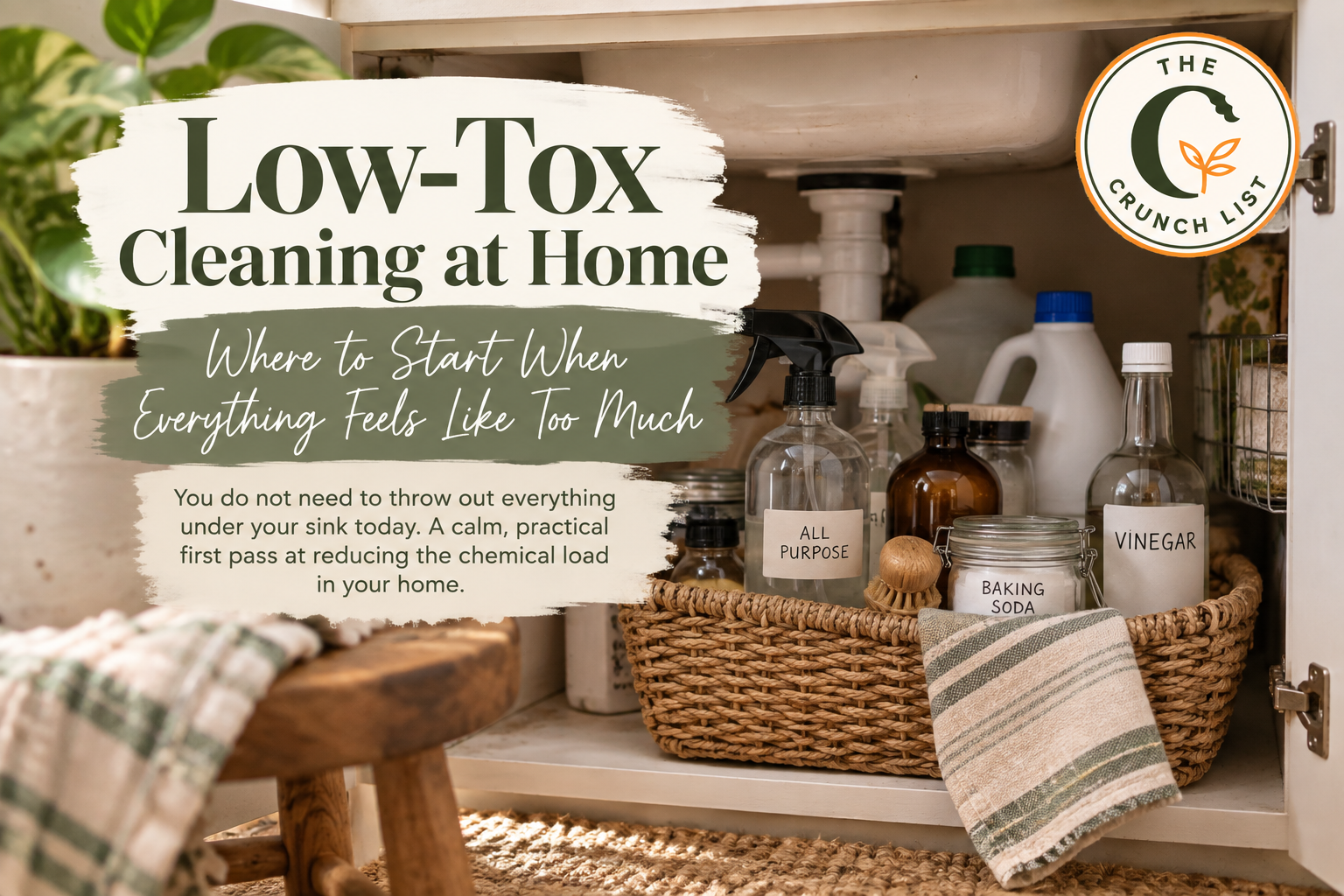
You do not need to throw out everything under your sink today. A calm, practical first pass at reducing the chemical load in your home.