Food & Sourcing
A Beginner's Guide to Raw Milk in Texas
How herd shares work, what the law says, and where to start locally.
The Crunch List · August 26, 2026 · 8 min read
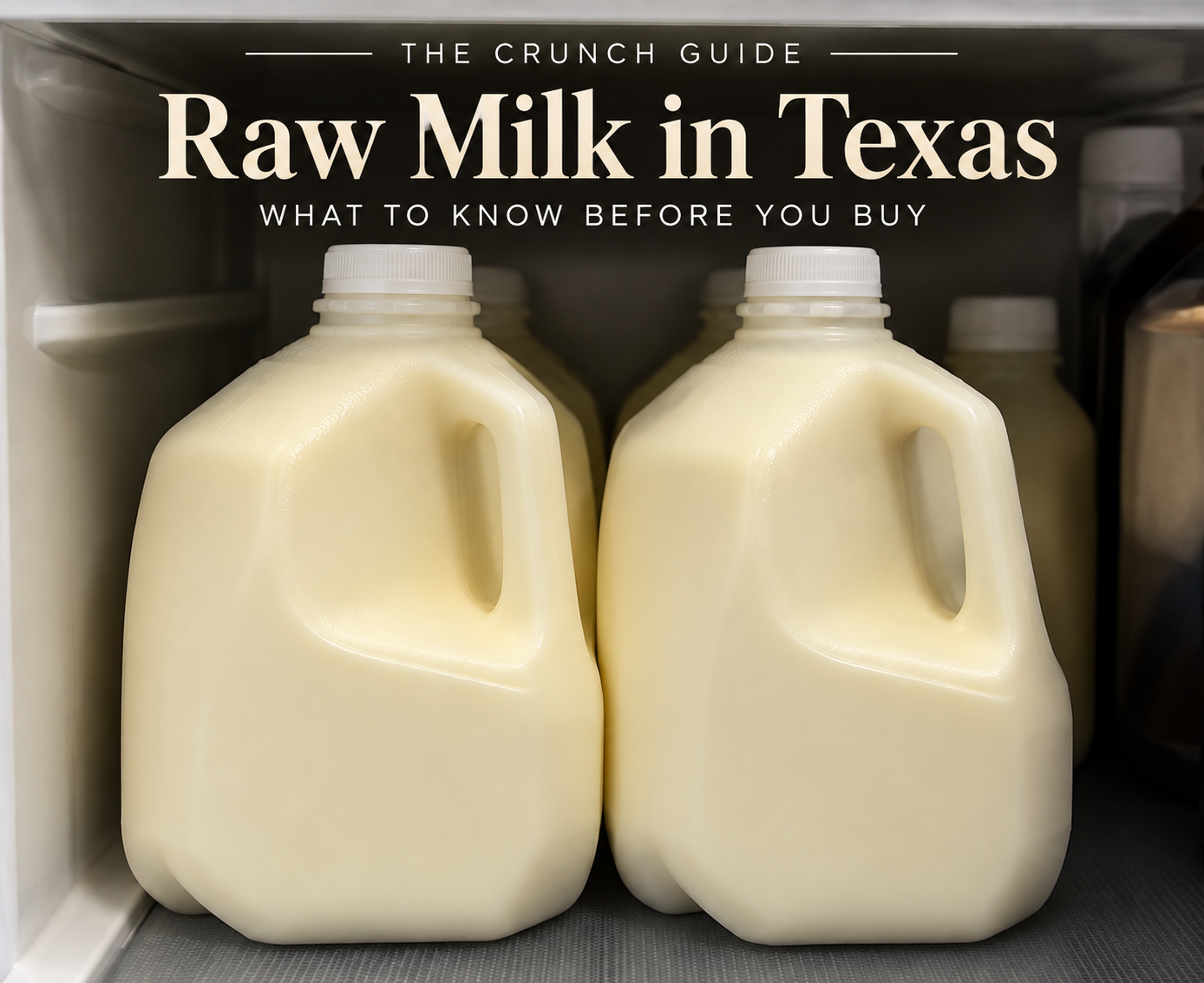
Maybe you’ve heard a friend talk about picking up a gallon from a local farm. Maybe “raw milk” keeps appearing in your Instagram feed. Or maybe you’ve officially reached the stage of crunchy living where you find yourself researching dairy farms on a Tuesday night. Welcome. You’re among friends. Raw milk has become increasingly popular among families looking to buy more of their food directly from local farmers and know a little more about where their food comes from. But if you’re new to it, figuring out where to buy raw milk in Texas can be surprisingly confusing. Is it legal? Do you have to drive to a farm? What exactly is a herd share? Can you buy it at a farmers’ market? And how do you decide which farm you feel comfortable buying from? Here’s the beginner-friendly version.
First Things First: What Is Raw Milk?
Raw milk is simply milk that has not been pasteurized.
Pasteurization heats milk for a specific amount of time to kill potentially harmful microorganisms. Most milk sold in traditional grocery stores in the United States is pasteurized.
Raw milk skips that step.
Depending on the farm, you may also encounter terms like:
- A2/A2 milk
- Grass-fed
- Pasture-raised
- Jersey milk
- Low-temperature pasteurized
- Non-homogenized
- Cream-top milk
These terms aren't interchangeable with raw. They tell you different things about the cows, farming practices, processing, or characteristics of the milk.
For example, milk can be A2/A2 and pasteurized, or raw without being A2/A2.
That distinction is worth knowing when you're comparing local farms.
Is Raw Milk Legal in Texas?
Yes. Raw milk can legally be sold for human consumption in Texas under specific regulations.
Texas requires dairies selling raw milk and raw milk products to the public to hold a Grade “A” Raw for Retail license. Licensed dairies are inspected by the Texas Department of State Health Services, and their milk is sampled at least quarterly.
Texas currently allows a permitted raw milk processor to sell Grade A raw milk directly to the consumer at the dairy farm. A permitted producer or its employee may also deliver an order to a location agreed upon with the customer, provided the delivery complies with local ordinances.
There is an interesting distinction when it comes to farmers’ markets.
You cannot simply walk up to a regular farmers’ market booth and purchase or sample raw milk there. Texas law specifically prohibits the sale or sampling of raw milk at farmers’ markets.
However, a licensed producer can deliver a previously arranged customer order to an agreed-upon location, including a farmers’ market, provided the other requirements are met.
In other words:
- Buying raw milk directly from a properly licensed Texas dairy? Yes.
- Arranging delivery from that dairy? Potentially, yes.
- A vendor setting out raw milk at a farmers’ market for anyone walking by to purchase? No.
And that's why buying raw milk can look a little different from buying eggs or sourdough at your Saturday market.
So…What Is a Herd Share?
This is where things start sounding much more complicated than they actually are.
A herd share is essentially an arrangement where you purchase an ownership interest in a cow, goat, or dairy herd.
Instead of thinking:
“I buy a gallon of milk from the farmer every week.”
Think:
“I own a tiny share of the herd, the farmer cares for and milks the animals, and I receive a portion of what my share produces.”
Typically, members sign an agreement and may pay:
- an initial herd-share or ownership fee;
- a recurring boarding or care fee; and
- sometimes additional fees based on the amount of milk or dairy products they receive.
The exact structure varies significantly from farm to farm.
You’ll find Texas farms currently operating herd-share programs for both cow and goat milk, although a herd share is not required simply because you want raw milk in Texas. Texas also has a regulated Raw for Retail dairy system through which licensed farms sell directly to consumers.
If you’re considering a herd share, read the farm's agreement carefully and ask how its particular program is structured and how it complies with current Texas requirements.
What About Safety?
This is an important part of the conversation—and one we don't think should be skipped simply because raw milk is popular in natural-living circles.
Raw milk is unpasteurized, which means it can contain harmful pathogens.
The CDC advises against consuming raw milk because it can carry organisms including E. coli, Salmonella, Campylobacter, Listeria and Brucella. Children under 5, pregnant women, adults 65 and older, and people with weakened immune systems are at increased risk of serious complications from foodborne illness.
Texas does regulate licensed Raw for Retail dairies. DSHS says licensed dairies are inspected and their raw milk is tested at least quarterly. Testing includes bacterial counts as well as testing for pathogens such as Salmonella, Listeria, E. coli O157 and Campylobacter.
That doesn't make raw milk risk-free.
It does mean you can do more than simply take someone's word for it.
Questions to Ask Before Choosing a Raw Milk Farm
One of our favorite things about buying directly from farmers is that you're allowed to ask questions.
In fact, you should.
You don't need to interrogate your farmer like you're conducting a federal investigation, but don't be shy about learning how the farm operates.
Consider asking:
Are you a licensed Texas Raw for Retail dairy?
If the farm is selling raw milk to the public through Texas's Raw for Retail program, you can also check the state's current list of registered dairies.
How often is your milk tested?
Ask what they test for and whether they make results available to customers.
How quickly is the milk chilled after milking?
Temperature control is an important part of dairy handling.
How are the milking equipment and containers cleaned?
A good producer should be comfortable explaining the process.
How are the cows or goats raised and fed?
Some families specifically want grass-fed, pasture-raised or A2/A2 dairy. Don't assume those things simply because the milk is raw.
Can we visit the farm?
Not every working farm can accommodate casual visitors, but openness about its practices is a good sign.
How does pickup work?
Some farms have an honor-system refrigerator. Others have designated pickup days, delivery routes or neighborhood drop locations.
And because we're in Texas:
Bring a cooler.
Raw milk and a 105-degree car are not a pairing we recommend.
Raw Milk vs. A2/A2 Milk: Are They the Same Thing?
No—and this is probably one of the most common sources of confusion for newcomers.
Raw describes how the milk was processed.
A2/A2 refers to the type of beta-casein protein produced by the cow.
Some cows naturally produce only A2 beta-casein, while others produce A1, A2 or a combination.
So you can have:
- raw A2/A2 milk;
- pasteurized A2/A2 milk;
- raw milk that isn't A2/A2; or
- pasteurized conventional milk.
If A2/A2 matters to you, ask the farmer rather than assuming.
Where Can You Find Raw Milk Near San Antonio?
This is one area where living in South Central Texas has its advantages.
There are several farms and local-food communities around the San Antonio area offering access to raw dairy, including licensed Raw for Retail dairies and farms using membership or herd-share arrangements.
A few places worth researching include:
Miller Farms Raw Milk — La Coste
A family dairy west of San Antonio offering direct farm access to raw cow's milk.
Holy Cow Creamery — Bulverde
Holy Cow Creamery appears on the Texas DSHS list of registered Raw for Retail dairies and offers a convenient Hill Country option north of San Antonio.
Feathers of Faith Farm — Bulverde
A small family farm offering A2/A2 raw dairy and a local farm-store experience.
Pura Vida Farm SA — Natalia
A south-of-San-Antonio option offering raw dairy through a herd-share-style model.
HR Herdshare / Huevos Ranchero — Stockdale
A goat dairy herd share southeast of San Antonio with raw goat milk and pickup options for members.
There are also local-food pickup communities that connect San Antonio families with farms and dairy producers without requiring a separate trip to every farm.
Because licenses, availability, herd sizes, pickup locations and membership openings can change, always confirm directly with the farm before making the drive.
An Easier Way to Find Local Raw Milk
This is exactly why we created The Crunch List.
Finding local food shouldn't require digging through six-year-old Facebook posts, joining seventeen groups and following directions that begin with, “Turn left after the old red barn.”
The Crunch List is building a local directory of farms, ranches, markets and natural-living businesses throughout San Antonio and the surrounding area so you can more easily discover what's available near you.
Explore our Raw Milk & Local Dairy listings to find farms near San Antonio, compare their offerings and learn how to purchase directly from them.
Before You Buy Your First Gallon…
If you're curious about raw milk, start with the farmer rather than the trend.
Learn how the animals are raised.
Ask how the milk is handled.
Understand whether you're purchasing from a licensed Raw for Retail dairy or participating in another arrangement.
Ask about testing.
Read the agreement if you're joining a herd share.
And decide what makes sense for your own household.
There is something pretty special about knowing the people behind your food—and whether you ultimately choose raw milk or not, getting more connected to the farms producing food in our community is something we can absolutely get behind.
Want to find more local farms, ranches and natural food sources?
Explore The Crunch List — San Antonio, your local guide to living a little crunchier.
------------------------------------------------------------------------ The Crunch List provides local information for educational purposes and does not provide medical or legal advice. Raw milk is an unpasteurized food and carries foodborne-illness risks. Consult current Texas regulations and appropriate healthcare guidance when making decisions for your household.
Sources:
- Texas Department of State Health Services — Raw Milk for Retail Sale
- Texas DSHS — Registered Raw for Retail Dairy Farms
- Texas DSHS — Texas Farmers’ Market Rules
- CDC — Raw Milk