

Getting Started
New to Crunchy Living in San Antonio? Start Here
No purges, no perfectionism. A sane on-ramp to eating better, cleaning safer, and raising kids a little crunchier in San Antonio.
The Crunch List · Aug 18, 2026
Low-Tox Home
You do not need to throw out everything under your sink today. A calm, practical first pass at reducing the chemical load in your home.
The Crunch List Editorial Team · September 18, 2026 · 9 min read
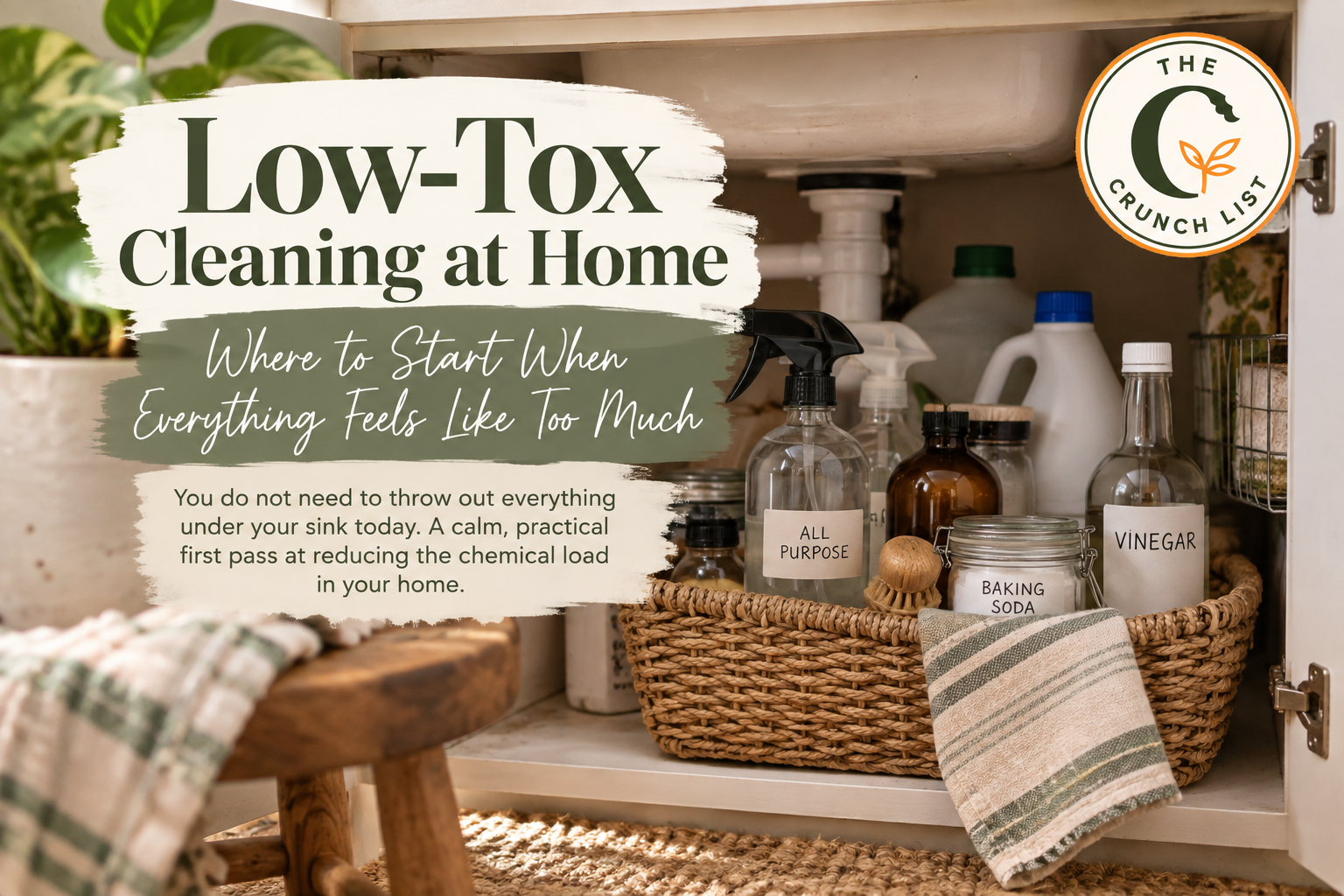
You do not need to throw out everything under your sink today. Here’s a calm, practical first pass at reducing the chemical load in your home—without replacing your entire cleaning cabinet overnight.
Maybe you opened Instagram looking for a dinner recipe and somehow ended up 20 minutes deep into videos telling you that your dish soap, laundry detergent, disinfecting spray, candles, dryer sheets, floor cleaner, and favorite lemon-scented everything are all trying to kill you.
Welcome to crunchy living. 😂
It can get overwhelming fast.
Once you start paying attention to the ingredients in the products you use around your home, it’s easy to feel like you need to grab a trash bag, empty every cabinet, spend $300 at the health-food store, and start making homemade cleaner in your kitchen before bedtime.
You don’t.
In fact, if you’re trying to create a lower-tox home that you can actually maintain, slow and sustainable is probably the better approach.
You are not trying to win an award for the crunchiest cleaning cabinet.
You are simply trying to make the next better choice.
There isn’t one official definition of a “low-tox” home.
For our purposes, think of low-tox cleaning as reducing unnecessary exposure to ingredients that may irritate your skin, lungs, or indoor air while still keeping your home genuinely clean.
That distinction matters.
Cleaning products can contain volatile organic compounds, or VOCs, as well as fragrances and other ingredients that may contribute to eye or throat irritation, headaches, allergic reactions, or respiratory problems in some people. The American Lung Association recommends choosing products with fewer VOCs, fragrances, irritants, and flammable ingredients when possible. Source:[link text]((American Lung Association))
But “natural” on the front of a bottle doesn’t automatically mean safer.
Even plant-derived fragrances and essential oils can be irritating or trigger allergic reactions in sensitive people, which is why it’s worth looking beyond the marketing language on the label. Source:(Environmental Working Group)
So the goal isn’t necessarily:
Chemical = bad. Natural = good.
Everything is made of chemicals.
A better question is:
Do I need this ingredient or exposure in my home, and is there a simpler option that works just as well?
That mindset makes this whole process much easier.
This is the part I wish someone would tell every person starting a low-tox journey:
You can use things up and replace them as you go.
If you have a perfectly good bottle of window cleaner under your sink, you do not necessarily need to throw it into the trash tonight.
Instead, start a mental—or literal—replacement list.
When the laundry detergent runs out, buy a better one.
When the all-purpose cleaner is empty, replace it.
When you finish the dishwasher pods, try another option.
Over several months, your cabinets can look completely different without one giant shopping trip or a pile of half-used products going to waste.
For most families, that is a much more realistic way to make lasting changes.
You do not need to investigate every obscure bottle hiding behind the plumbing under your bathroom sink.
Start with frequency.
What are you touching, spraying, inhaling, or washing your clothes and dishes with all the time?
For many homes, the first five categories worth looking at are:
If you only changed those categories over the next few months, you would have already simplified a large portion of your everyday cleaning routine.
And honestly? You may discover that you don't need nearly as many separate cleaners as you thought.
If reading ingredient labels makes your eyes cross, start here:
Choose fragrance-free when it makes sense.
Fragrance doesn't make your countertop cleaner.
It makes your countertop smell like “Tropical Rainforest Waterfall.”
Those are two different jobs.
The American Lung Association specifically recommends avoiding or reducing fragranced cleaning products and air fresheners, and the EPA even offers an additional Fragrance-Free Safer Choice designation for qualifying products that contain no fragrance materials. Source: American Lung Association
This can be one of the simplest low-tox swaps because you don't have to become an ingredient expert.
Look for terms such as:
Fragrance-free
Unscented
Free & clear
One caution: “unscented” does not always mean a product contains absolutely no fragrance ingredients, so fragrance-free is usually the clearer choice when avoiding added scent is your goal. EWG recommends checking ingredient disclosures when possible. Source: Environmental Working Group
And yes, your house may eventually stop smelling like “clean laundry.”
That doesn't mean it isn't clean.
Before replacing ten conventional cleaners with ten expensive “clean” cleaners, ask:
Do I actually need ten cleaners?
Probably not.
For ordinary household cleaning, simple options can cover a surprising amount of territory.
The American Lung Association notes that warm water and soap often work for basic household cleaning, with baking soda useful for scrubbing and diluted vinegar useful for some glass-cleaning applications. Source: American Lung Association
A simple cleaning cabinet might eventually include:
That’s it.
You don't necessarily need one spray for granite, one for stainless steel, one for glass, one for stovetops, one for refrigerators, and another one whose only apparent purpose is making the kitchen smell like lemons.
Important: Simple does not mean mix everything together.
Homemade cleaners aren't automatically safer just because the ingredients came from your pantry.
Never mix cleaning products unless you know the combination is safe. In particular, never mix chlorine bleach with ammonia, vinegar, or other acidic cleaners. Dangerous gases can be produced. Source: [link text](Environmental Working Group)
Sometimes the safest DIY cleaning recipe is simply:
Don't play chemist.
You could spend hours researching surfactants, preservatives, solvents, fragrances, enzymes, and every ingredient ending in -something-you-can't-pronounce.
Or you could let reputable certification systems help you narrow down your choices.
Look for EPA Safer Choice
The EPA's Safer Choice program evaluates every ingredient in qualifying products against human-health and environmental criteria. The program also requires products to meet performance standards, so the idea isn't just “safer ingredients”—the cleaner still has to work. Source: [link text](US EPA)
The EPA maintains a searchable database of certified products, including a filter specifically for fragrance-free options. Source: [link text](US EPA)
That little blue-and-green Safer Choice logo can make shopping considerably easier.
EWG's Guide to Healthy Cleaning Can Also Help
Environmental Working Group's Guide to Healthy Cleaning evaluates thousands of cleaning products and ingredients and can be useful when you're trying to compare options or decode a product you've already purchased. Source: [link text](Environmental Working Group)
You do not have to agree with every rating system perfectly for it to be useful.
Think of these tools as shortcuts—not commandments.
This one deserves its own section because we have been thoroughly trained to associate scent with cleanliness.
Lemon means kitchen.
Pine means floors.
“Fresh linen” apparently means laundry.
And whatever “Ocean Breeze” is supposed to mean, we've accepted that too.
But adding fragrance to the air isn't cleaning the air.
Consider gradually reducing:
Opening the windows when weather allows, running ventilation fans, washing fabrics that are holding odors, taking out trash, and addressing the actual source of a smell may be decidedly less glamorous—but it works.
And ventilation matters even when you're using better cleaning products. The American Lung Association recommends opening windows and doors and avoiding using cleaning chemicals in small, poorly ventilated spaces. Source: [link text](American Lung Association)
Still overwhelmed?
Forget the whole house.
Pick one room.
Start with the kitchen.
Replace products as they run out:
Dish soap → dishwasher detergent → all-purpose cleaner.
Done.
Or choose the laundry room:
Detergent → stain remover → dryer sheets.
Done.
Or the bathroom:
Counter cleaner → toilet cleaner → shower cleaner.
Done.
Then stop.
Live your life.
Feed your kids.
Make dinner.
Go outside.
Low-tox living is supposed to support your life—not become your entire life.
What I Would Replace First
If a friend told me, “Okay, I want to clean up our cleaning products, but tell me exactly where to start,” this would be my order:
1. Air fresheners
They're an easy product to eliminate because they aren't actually necessary for cleaning.
2. Everyday surface cleaner
You probably use it constantly, making it a high-impact replacement.
3. Laundry detergent
Your clothes, towels, sheets, pajamas, and children's clothes spend a lot of time against your skin.
4. Dish soap and dishwasher detergent
These are everyday-use products and relatively easy to replace.
5. Heavily fragranced laundry extras
Think scent beads, fabric sprays, and strongly scented dryer sheets.
6. Specialty cleaners
Oven cleaner, furniture polish, stainless-steel spray, carpet cleaners, and the random bottles you use twice a year can come later.
You don't have to start with the thing you use once every six months.
Start with the things you use every Tuesday.
When you're standing in the cleaning aisle comparing six bottles that all have leaves printed on them, keep it simple.
Look for:
✓ Fragrance-free when possible
✓ Clear ingredient disclosure
✓ EPA Safer Choice certification when available
✓ Fewer unnecessary specialty products
✓ Products made for the actual job you need
✓ Something you can afford to buy again
That last one matters.
A $28 bottle of countertop cleaner isn't a practical low-tox swap if you're going to resent buying it every month.
Sustainable habits have to be sustainable for your budget too.
This might be the most important part.
There will probably always be something in your house that wouldn't earn a gold star from the crunchy internet.
That's okay.
Maybe Grandma gave you scented laundry detergent.
Maybe your husband loves the aggressively pine-scented floor cleaner.
Maybe one particular conventional stain remover is the only thing standing between your toddler's clothes and permanent spaghetti stains.
This isn't about purity.
It's about reducing where reducing makes sense.
And often, the most meaningful changes are incredibly ordinary:
Buying fragrance-free detergent.
Opening a window while cleaning.
Skipping the plug-in air freshener.
Using one cleaner instead of six.
Checking a product before automatically buying the same bottle you've purchased for ten years.
Small swaps add up.
If you're just beginning, here is your entire assignment:
Choose one product.
When it runs out, replace it with a better option.
Then do it again.
Six months from now, you may look under your sink and realize that you've completely changed the way you clean your home—without ever having a dramatic “throw everything away” day.
That is the kind of crunchy living we're after around here.
Not perfection.
Just paying attention, asking better questions, supporting better businesses when we can, and making the next good choice.
One bottle at a time.
Getting Started
No purges, no perfectionism. A sane on-ramp to eating better, cleaning safer, and raising kids a little crunchier in San Antonio.
Low-Tox Home
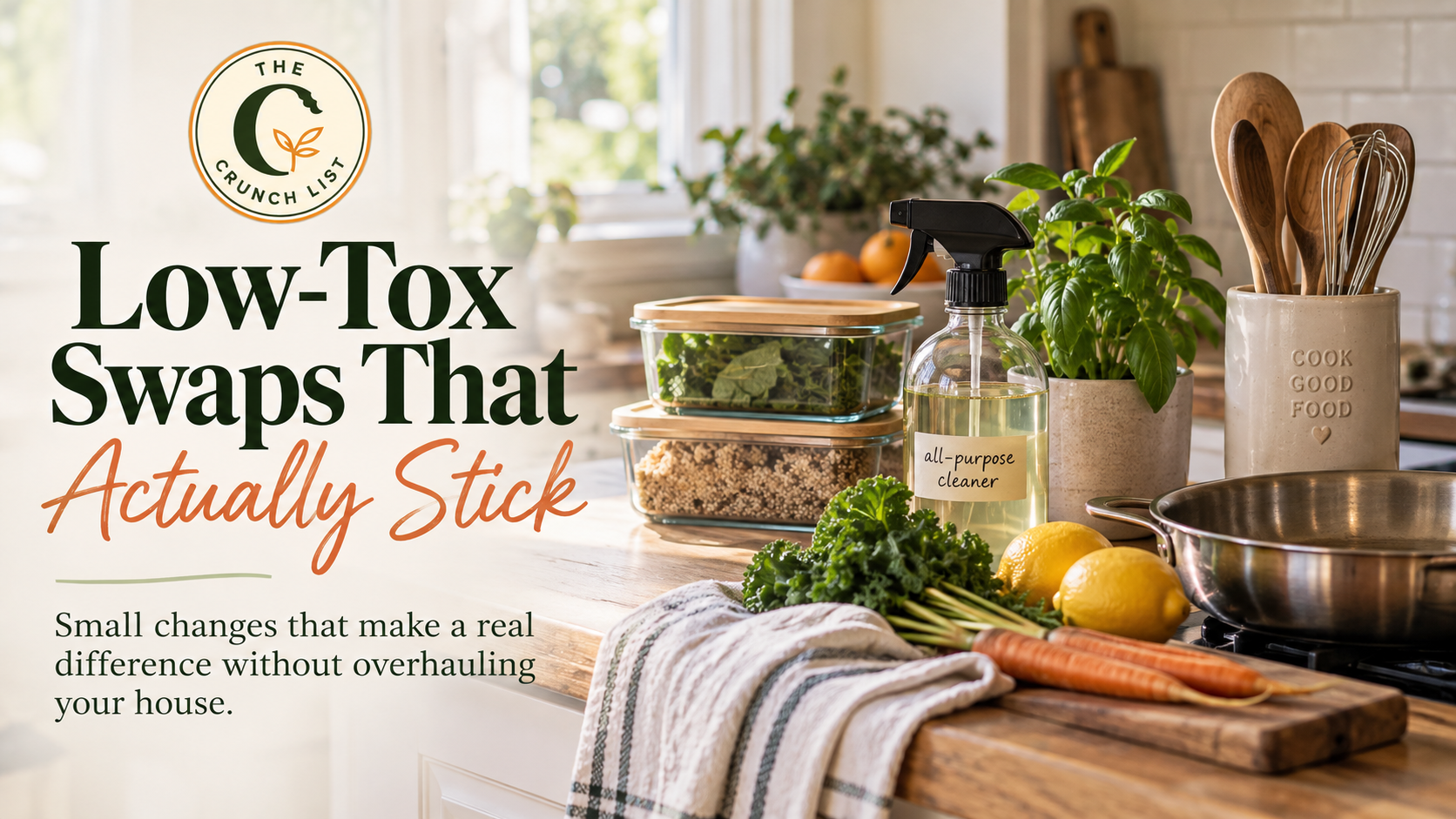
Small changes that make a real difference without overhauling your house.