

Low-Tox Home
Low-Tox Swaps That Actually Stick
Small changes that make a real difference without overhauling your house.
The Crunch List · September 9, 2026 · 8 min read
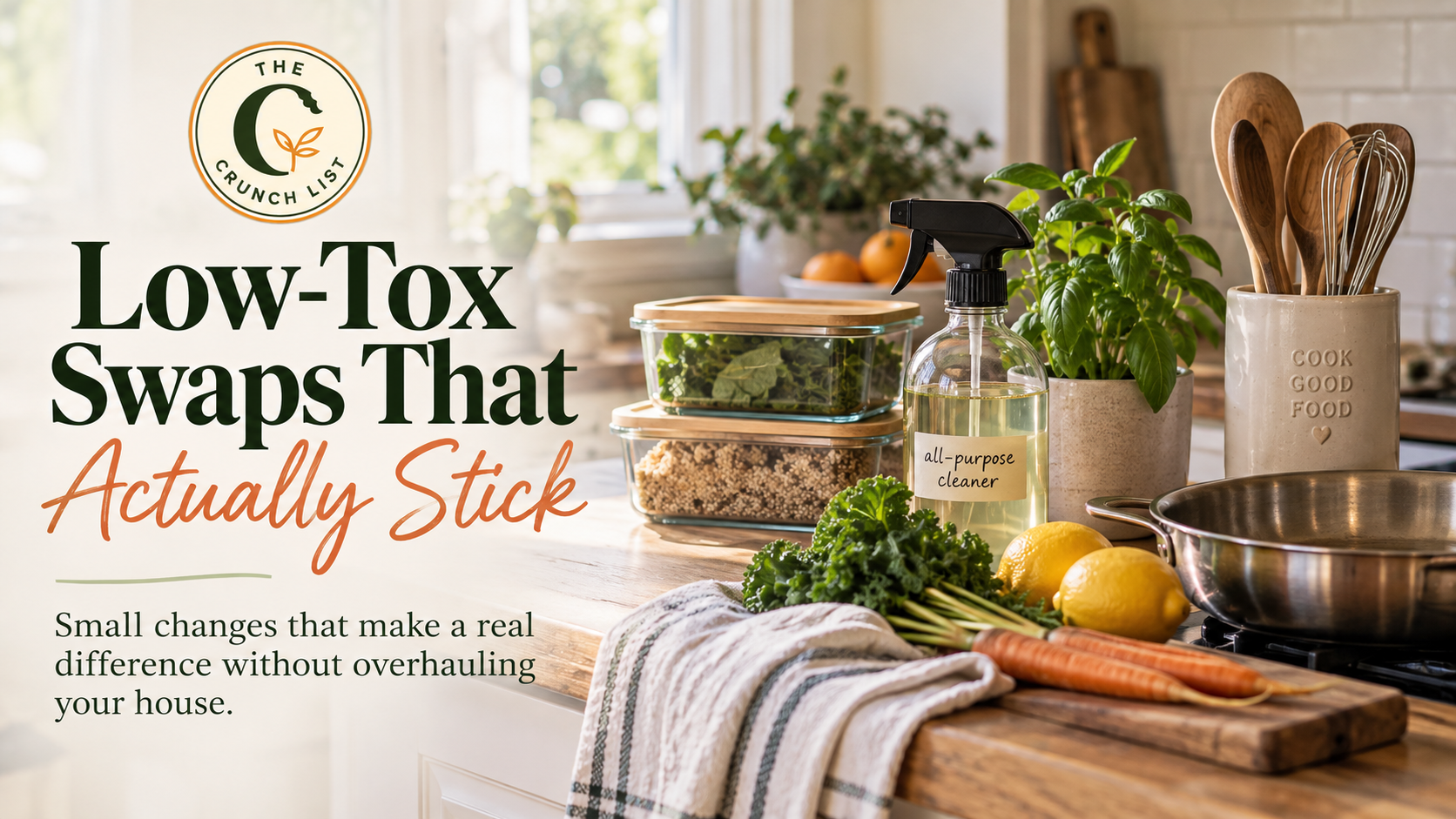
Small changes that make a real difference without overhauling your house.
You start reading about low-tox living and suddenly everything in your house looks suspicious.
The laundry detergent.
The candles.
The frying pan.
The shampoo.
The plastic containers.
The couch you bought six years ago and were perfectly happy with until approximately 14 minutes ago.
And before you know it, “I’d like to make a few healthier choices” has somehow turned into a mental list of 47 things you need to replace immediately.
No, thank you.
One of the easiest ways to make low-tox living feel impossible is to approach it like a complete household renovation.
The better approach?
Start with what you use often. Replace things as they run out. Make swaps that fit your actual life. And remember that reducing unnecessary exposures is still worthwhile even if you never create a perfectly “non-toxic” home.
Because you probably won’t.
None of us will.
And that’s okay.
Low-tox living doesn’t have to mean purging your cabinets, spending hundreds of dollars at once, or becoming afraid of every ingredient you can’t pronounce.
Here are some simple low-tox swaps that are realistic enough to actually stick.
First: You Don't Have to Replace Everything
This may be the most important low-tox tip of all:
Use what you have and replace intentionally.
Unless there is a specific product you have a compelling reason to stop using immediately, you generally do not need to walk through your house with a garbage bag.
When the laundry detergent runs out, try a different one.
When your plastic food containers finally crack, replace them with glass.
When you finish your current body lotion, look for a simpler alternative.
That approach is slower — but it is also much more sustainable financially and mentally.
Think of low-tox living less like a dramatic makeover and more like slowly changing the direction of your household.
A degree or two at a time adds up.
1. Start With the Products You Use Every Day
If you want the biggest return for the least amount of effort, look at frequency first.
A product you use once a year probably doesn't need to be your first priority.
The products touching your skin, dishes, laundry, food, and indoor air every single day are a much more logical place to start.
A few examples:
- Laundry detergent
- Dish soap
- Hand soap
- Household cleaners
- Deodorant and personal care products
- Food storage containers
- Cookware
- Air fresheners and candles
You do not need to tackle that entire list this weekend.
Choose one.
When that becomes normal, choose another.
2. Simplify Your Cleaning Cabinet
This is one of the easiest places to become overwhelmed because there seems to be a special cleaner for absolutely everything.
Kitchen cleaner.
Bathroom cleaner.
Glass cleaner.
Floor cleaner.
Stainless steel cleaner.
Tub cleaner.
Countertop cleaner.
Somewhere along the way, we were convinced every surface in the house needed its own bottle.
It usually doesn't.
For everyday cleaning, many households can simplify considerably with a good all-purpose cleaner, dish soap, microfiber cloths, and a few targeted products for jobs that actually require them.
If you're trying to create a lower-tox home, look for cleaning products with simpler ingredient lists and fewer added fragrances.
And don't underestimate ventilation.
Opening windows when weather allows, running exhaust fans, and getting fresh air moving through the house are wonderfully unglamorous healthy-home habits.
No aesthetic glass spray bottle required.
Make this swap when:
Your current cleaners run out.
There's no need to replace an entire cleaning cabinet overnight.
3. Rethink the Constant Fragrance
This can be a surprisingly impactful change because fragrance tends to show up everywhere.
Laundry detergent.
Fabric softener.
Dryer sheets.
Plug-ins.
Room sprays.
Candles.
Trash bags.
Hand soap.
Body wash.
Even products whose main purpose has absolutely nothing to do with smelling like “Midnight Cashmere Rainforest.”
If you're interested in low-tox living, reducing unnecessary synthetic fragrance is a practical place to begin.
You don't have to ban every pleasant smell from your house.
You might simply start by eliminating the products that continuously release fragrance into your indoor air — especially plug-ins and automatic air fresheners — and choose fragrance-free versions of everyday products where it makes sense.
Then keep the scents you genuinely enjoy rather than layering fragrance on top of fragrance all day long.
An easy first step:
Switch your laundry detergent to an unscented or fragrance-free version when your current bottle runs out.
It's one change that quietly affects clothes, towels, sheets, pajamas, and everything else your family wears against their skin.
4. Replace Plastic Food Storage as It Wears Out
You do not need to throw away every plastic container in your kitchen tonight.
But food storage is an easy category to gradually upgrade.
As plastic containers become scratched, stained, warped, or mysteriously lose their lids — as they inevitably do — replace them with glass or stainless steel options.
You can also prioritize using glass for hot foods, leftovers, and reheating.
This is the kind of swap that works particularly well because it doesn't require you to change a habit.
You're still putting leftovers in a container.
You're just slowly changing what the container is made of.
And those are often the best low-tox swaps: the ones that don't require extra effort every time you use them.
5. Take a Look at Your Cookware
Cookware can become an expensive rabbit hole very quickly, so don't let the internet convince you that you need a $700 kitchen overhaul before dinner.
You don't.
If you're ready to replace a worn-out pan, consider materials such as:
- Stainless steel
- Cast iron
- Carbon steel
- Enameled cast iron
The right choice depends on what you cook, how much maintenance you're willing to tolerate, and your budget.
Stainless steel is especially versatile once you learn how to use it correctly.
Cast iron is inexpensive and incredibly durable.
Enameled cast iron is wonderful but can be pricey.
The goal isn't to own the “perfect” cookware collection.
It's to make a better choice the next time something genuinely needs replacing.
6. Skip the Shoes Indoors
This may be the least exciting suggestion in this entire article.
It may also be one of the easiest.
Shoes travel through parking lots, public restrooms, sidewalks, lawns, stores, and approximately six thousand other places before arriving on your living room floor.
Creating a shoes-off habit helps reduce how much outdoor dirt and residue gets tracked throughout the house.
Put a basket or shoe rack near the entryway.
Keep slippers nearby if you hate walking barefoot.
Done.
No subscription required.
No complicated ingredient label to decipher.
No $38 bottle of anything.
Sometimes the crunchiest solutions are also the cheapest.
7. Filter Your Water — But Don't Panic-Buy a Filter
Water filtration deserves its own entire Crunch Guide article because the “best” filter depends heavily on what you're actually trying to remove.
A beautiful countertop filter with excellent marketing is not automatically the right filter for your water.
Before spending a significant amount of money, learn what is in your local water and what the filter you're considering is certified or designed to reduce.
For some households, that may mean a basic carbon filter.
Others may choose a more comprehensive filtration system.
The important thing is to choose based on your needs — not fear.
Crunch Guide note: We'll be diving deeper into San Antonio water quality and filtration options in a future guide.
8. Don't Forget What Touches Your Skin All Day
Personal care can quickly become another category where people feel like they need to replace everything.
You don't.
Start with the products you use most frequently or over the largest areas of your body.
That might include:
- Body lotion
- Deodorant
- Body wash
- Shampoo and conditioner
- Makeup
- Sunscreen
Look for products that work well for your family first.
Because a “clean” shampoo that makes your hair feel like straw is probably not going to remain in your shower very long.
A product isn't a good swap if you hate using it.
Low-tox living has to function in real life.
9. Stop Trying to DIY Everything
Somewhere along the low-tox journey, many of us briefly become convinced that we are supposed to make our own deodorant, laundry detergent, sourdough starter, all-purpose cleaner, toothpaste, elderberry syrup, yogurt, beeswax wraps, and possibly furniture.
You are allowed to buy things.
Really.
DIY can be wonderful when you enjoy it, it saves money, or it gives you greater control over ingredients.
But homemade isn't automatically better simply because it was mixed in a mason jar.
Choose the things worth making to you.
Purchase the rest.
Your low-tox home does not need to become your full-time job.
10. When You're Renovating Anyway, Ask Better Questions
Some low-tox choices make the most sense when you're already replacing, repainting, or remodeling something.
Painting a room?
Look into low- or zero-VOC paint options.
Replacing flooring?
Research the materials and finishes before purchasing.
Buying furniture?
Pay attention to materials, finishes, and how much time you spend using the piece.
Replacing a mattress?
That's a logical moment to compare materials rather than tossing a perfectly functional mattress because someone on Instagram frightened you.
The key phrase here is:
when you're doing it anyway.
That's when healthier-material choices become much more practical.
And if you're hiring someone for a home project, ask.
You may be surprised how many painters, contractors, landscapers, cleaners, and other service providers are willing to accommodate lower-tox or environmentally conscious product requests when customers specifically request them.
11. Choose One “High-Impact, Low-Effort” Swap at a Time
If you're wondering where to begin, don't ask:
“How do I make my entire house non-toxic?”
Ask:
“What's one thing we use all the time that would be easy to change?”
Maybe it's:
Switching to fragrance-free detergent.
Taking shoes off at the door.
Replacing your next food storage container with glass.
Getting rid of plug-in air fresheners.
Opening the windows more often.
Choosing a simpler household cleaner.
Cooking with your stainless steel skillet more frequently.
None of those changes is dramatic.
That is precisely the point.
The Best Low-Tox Swap Is the One You Keep
There will always be another product you could research.
Another ingredient somebody on the internet thinks you should fear.
Another $92 organic object waiting patiently in your Instagram feed.
You don't need all of it.
Low-tox living is most helpful when it makes your household feel better — not when it becomes another source of anxiety or perfectionism.
Start with the things you use most.
Replace products as they run out.
Prioritize changes that don't create significantly more work.
Spend money where it makes sense.
And allow your home to become a little lower-tox over time.
Not perfect.
Just better.
That counts.
Want to Make Your San Antonio Home a Little Crunchier?
The Crunch List is all about making healthier, more intentional choices easier to find locally.
Explore San Antonio-area businesses offering natural products, environmentally conscious services, wellness resources, locally produced food, and more — without having to spend hours searching for them yourself.
Because living a little crunchier should feel doable.
Not exhausting.